
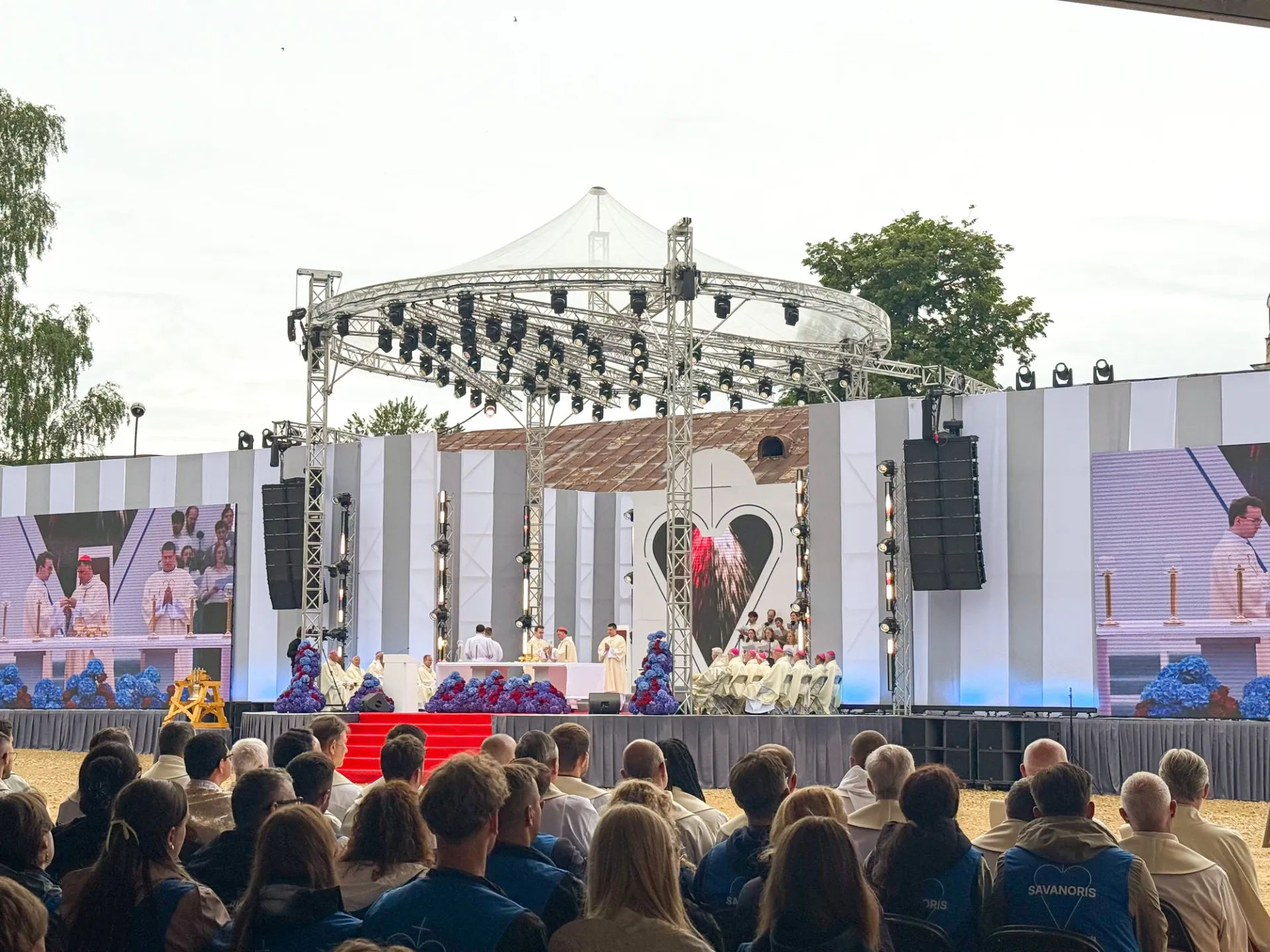
Your Eminence, Excellencies,
Reverend Sisters and Fathers,
Civil and Military Authorities,
Dear Brothers and Sisters in Christ,
I am pleased to be able to celebrate this Holy Eucharist with all of you, participants in the World Apostolic Congress on Mercy. I extend my heartfelt thanks to His Excellency Gintaras Grušas, Metropolitan Archbishop of Vilnius and President of the Lithuanian Bishops’ Conference, for the invitation.
In this meaningful place, on this hill of Vilnius, we are at the heart of the Divine Mercy, where the little Sister Faustina received the great message that now resounds throughout the world.
The two readings we have just heard may seem very different at first: on one side, the prophet Elijah in the desert; on the other, the Beatitudes proclaimed by Jesus on the mountain.
Yet together they reveal to us the real face of God’s mercy. Today’s Word of God speaks to us powerfully about trust, poverty, and blessedness.
In the First Book of Kings, we meet the prophet Elijah. It is a difficult time: drought, famine, uncertainty. And God asks something surprising of him. God asks him to trust. “Elijah, go… and I will feed you.”
Elijah, a man of God, obeys the Lord’s command and withdraws to the brook Cherith.
There he has nothing — no bread and no water. Yet God provides for him in a surprising way: ravens bring him food twice a day, and the brook gives him water to drink.
The nourishment comes in a simple and unexpected way: through ravens, through a stream. Not something spectacular, but through daily providence.
In this way Elijah learns to live by God’s mercy alone. He has no human reserves, no guarantees — only the word of the Lord. And that word is enough.
Elijah does not know everything, he does not understand everything, but he entrusts himself to God. And precisely there, in that fragility, he experiences God’s care.
How many of us, during this World Apostolic Congress on Marcy, can recognize our own story in Elijah’s? How many have experienced a time of “dryness” in life — loneliness, illness, financial difficulties, or spiritual crisis — and have heard the Lord say: “Stay here, I will provide for you”? Divine Mercy is not merely a beautiful idea; it is the God who sends ravens, who makes water flow in the desert, and who never abandons those who trust in Him.
This is already a real face of mercy: God takes care of us, even when life feels dangerous and difficult.
Our late Pope Francis, during his apostolic journey to Lithuania at 2018, here in Vilnius at the meeting with youth said: “Jesus looks within us; He does not stop at appearances.
He looks at the heart, where there are often wounds, fears, and closures. And precisely there He brings His mercy.”
“Mercy is the concrete way in which God comes close to us, takes us by the hand, and lifts us up.”
Jesus, in the Gospel, goes even deeper.In the Beatitudes, Jesus proclaims blessed are those who, in the eyes of the world, do not seem happy: the poor in spirit, those who mourn, the merciful, the meek, the persecuted.
But why are they blessed? The blessed have their hearts open to God. Because, like the prophet Elijah, they do not rely only on themselves, but they trust in God’s goodness and faithfulness.
And here, in the context of the World Apostolic Congress, these words take on an even deeper meaning.
Saint Sister Faustina, right here in Vilnius, received the message of Jesus, message of Mercy: “Jesus, I trust in You.”
This is the key to everything.
The poor in spirit is the one who says: “Jesus, I trust in You.” The one who mourns continues to say, even in suffering: “Jesus, I trust in You.”
The meek, the merciful, the persecuted… all find their strength in this trust.
Brothers and sisters, the Beatitudes are not a distant ideal, but a concrete path: to live by trusting in God’s mercy.
And mercy is not only something we receive, but something we are called to give.
In particular, today we are invited to reflect on these words: “Blessed are the merciful, for they shall receive mercy.”
In a world marked by divisions, wars, judgments, and hardness, the Christian is called to be a living sign of mercy in forgiveness, in listening, in patience, in closeness to those who suffer.
In the context of this World Apostolic Congress on Mercy, the Lord is asking us not only to receive His mercy but also to become its witnesses and bearers. Just as Elijah shared the gift he received, we are invited to bring God’s mercy into our families, workplaces, and communities.
Just as Elijah the prophet received bread in the desert, so we too receive God’s grace each day. And like those who are blessed from the Gospel, we are called to turn this grace into real life.
So, during this Congress, we can ask ourselves:
Where is the Lord inviting me today to trust more?
In which “desert” of my life am I called to believe in His providence?
How can I become an instrument of His mercy for others?
Let us ask the Lord for a simple but decisive grace: a trusting heart and a loving heart.
May the Virgin Mary, in Vilnius venerated with the title of Mother of Mercy, Saint Sister Faustina, and Saint John Paul II, intercede for us, so that this Congress may not remain only a beautiful memory, but the beginning of a life more deeply rooted in His Divine Mercy.
And with the simple words of Saint Faustina, let us repeat every day: “Jesus, I trust in You.”
Amen.
Card. Rolandas Makrickas
World Apostolic Congress on Mercy, Vilnius 2026