Homily by Cardinal Rolandas Makrickas

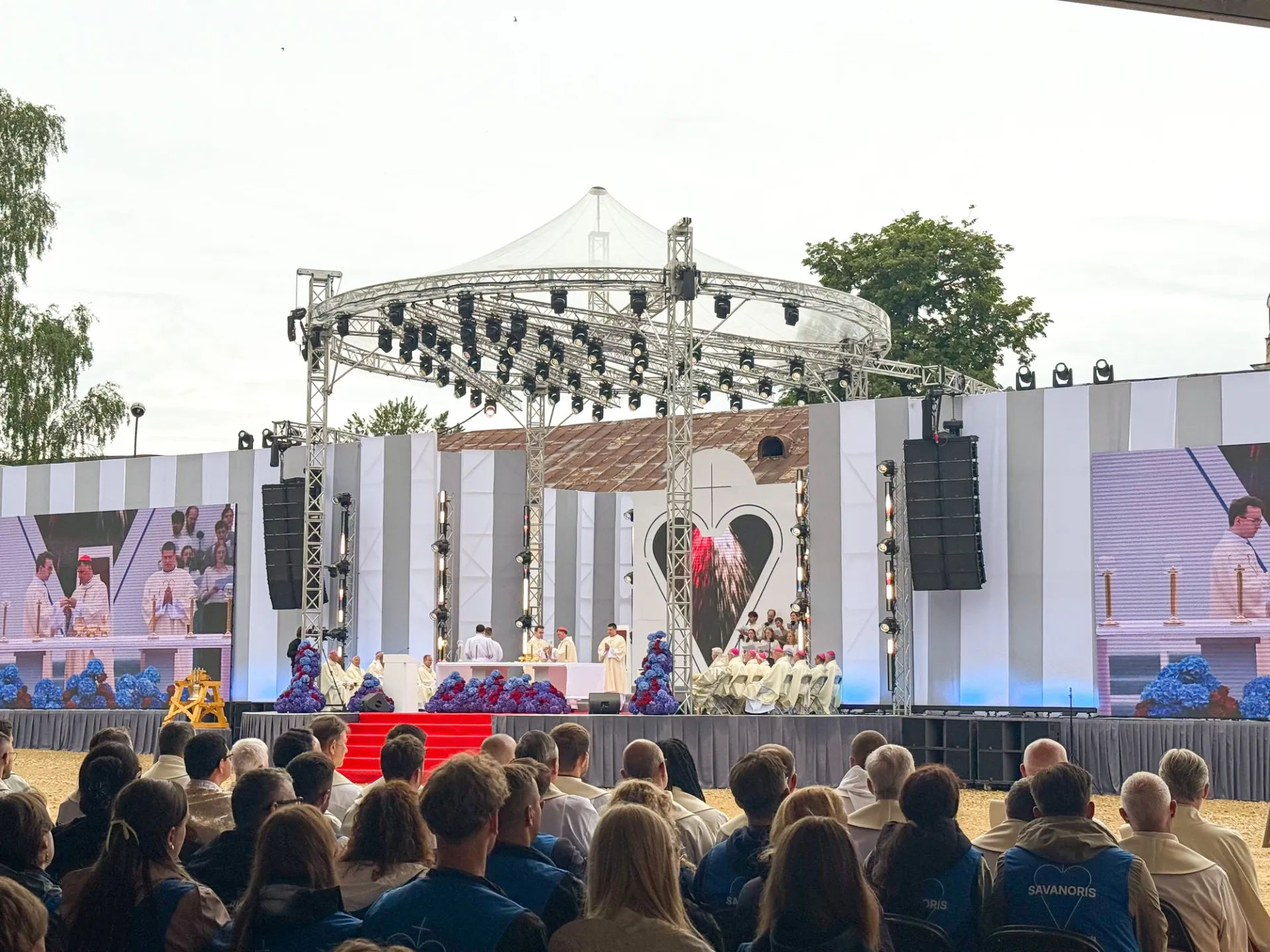
Your Eminence, Excellencies, Reverend Sisters and Fathers, Civil and Military Authorities, Dear Brothers and Sisters in Christ, I am pleased to be able to celebrate this Holy Eucharist with all of you, participants in the World Apostolic Congress on Mercy. I extend my heartfelt thanks to His Excellency Gintaras Grušas, Metropolitan Archbishop of Vilnius and … Skaityti toliau

Letter of Gintaras Grušas, Metropolitan Archbishop of Vilnius, to the Faithful: “Building a City of Mercy”

Dear brothers and sisters in Christ, As we begin a new liturgical year and continue our journey along the synodal path, we look forward to an extraordinary celebration. In June 2026, Vilnius will host the World Apostolic Congress on Mercy – a gathering that will encourage us to become witnesses of mercy. Therefore, beginning today, … Skaityti toliau

Feast of St. Faustina Kowalska. Homily by Archbishop Gintaras Grušas

My dear brothers and sisters in Christ, Today, the liturgy gives us readings that speak directly to the heart of our struggles: the cry for justice in the face of violence, the call to faith and courage, and the challenge of humble service. Providence has willed that these readings fall today, October 5th, on the … Skaityti toliau

Merry Christmas and a New Year filled with hope!

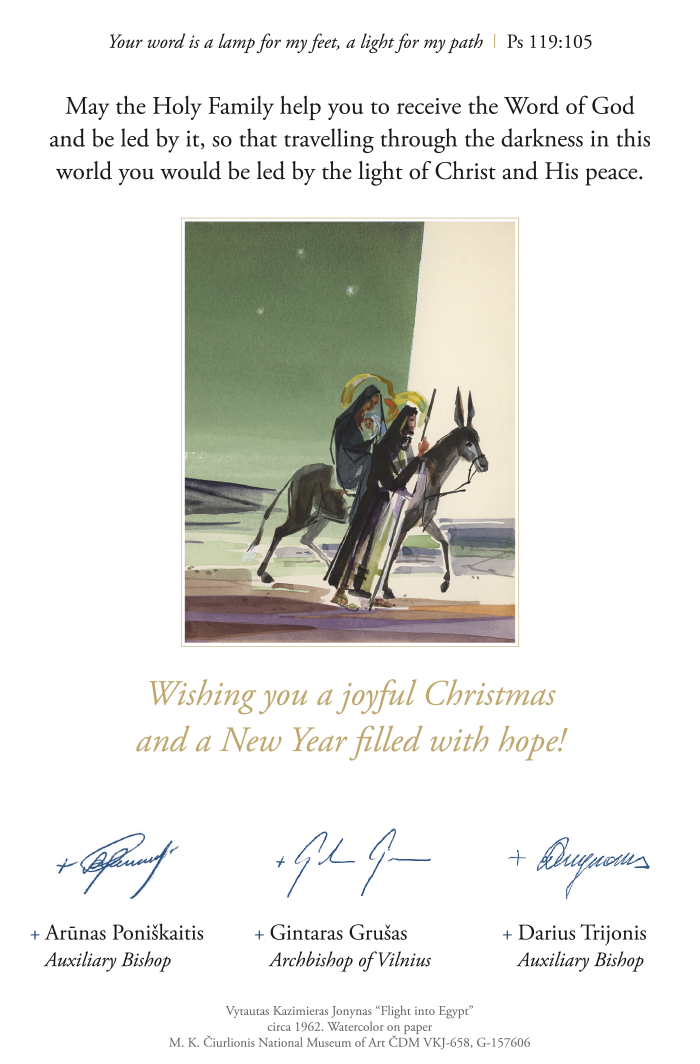
Your word is a lamp for my feet, a light for my path | Ps 119, 105

May the Holy Family help you to receive the Word of God and be led by it, so that travelling through the darkness in this world you would be led by the light of Christ and His peace.

Wishing you a joyful Christmas and a New Year filled with hope!

+Gintaras Grušas
Archbishop of Vilnius

+Arūnas Poniškaitis
Auxiliary Bishop

+Darius Trijonis
Auxiliary Bishop

Christmas 2023

George Weigel. St. John Paul II and the Renovation of Catholicism

Commemoration of the Thirtieth Anniversary of the Pastoral Visit of Pope John Paul II to Lithuania Vilnius 9 December 2023 ST. JOHN PAUL II AND THE RENOVATION OF CATHOLICISM by George Weigel Thank you for inviting me to join you in marking the thirtieth anniversary of Pope St. John Paul II’s pastoral pilgrimage to what … Skaityti toliau

The 400th Anniversary of the Martyrdom of St. Josaphat. The homily by abp. Gintaras Grušas

We gather today on the 400th anniversary of St. Josaphat‘s birth into heaven.  His life on earth touched many nations of the Polish-Lithuanian commonwealth, including the peoples of Ukraine, Lithuania, Poland and Belarus.   His life began in Volodymyr, he entered the monastery in Vilnius, where his faith life was formed.  He was consecrated as coadjutor … Skaityti toliau

The Homily of abp. Grušas in the Sinod’s Mass. St. Peter‘s Basilica

Homily
Feast of St. Luke – Synod 2023
Archbishop Gintaras Grušas

In God’s providence, we celebrate the Feast of St. Luke during the synod. His life and work demonstrate for us a synodal mentality. He shows us what we need to remember during our work. First of all, faithfulness and fortitude. Luke is faithful, as we heard in the first reading when Paul states „only Luke remains with me„. We too are called to remain faithful in our commitment to walk together in the life of the Church and through the difficulties of the journey, even when it is not clear where God is leading us in the short term.

St. Luke is the Marian evangelist par excellence, keeping the Mother of God before our eyes and her Magnificat praising the work of the Lord on our lips daily in the liturgy of the hours. Luke often highlights the important role of women in the life of the Church and in announcing the Good News – not only Mary, but the Samaritan woman at the well who announced the Messiah, Mary Magdelene, the first to announce the message of the Resurrection, as well as the various women throughout the Acts of the Apostles who assisted the growth of the early Church. Luke is also the one who describes, best of all, the traits of Jesus’ heart, who reveals to us the immensity of God’s divine mercy. He shows us how God always takes the first step towards the sinner as in the parable of the prodigal son (Lk 15); the compassion shown in the encounter with the widow of Nain (Lk 7); the tenderness and forgiveness to the sinner at the home of Simon the Pharisee (Lk 7), the love of neighbor in the parable of the Good Samaritan (Lk 10); salvation for the lost in the encounter with Zacchaeus (Lk 19).

In both his Gospel and in Acts, he shows clearly show that the Holy Spirit is the protagonist in the life and growth of the Church, as He must be in leading our synodal process. If Luke were documenting the synod, thanks be to God, he would find many of the themes that he favored at the forefront of our own deliberations in these days.

In today’s Gospel Jesus sends the 72 disciples out ahead of him to the places that he will visit. His first instruction is for them is to pray for more laborers for the harvest, for more who will announce the Good News that the Kingdom of God has come near to you. „The harvest is plenty, but laborers are few. Ask the Lord of the harvest to send laborers into the field.” In the announcement of the kingdom, the equality of all the baptized comes to the forefront – all are called to this, not just ordained ministers. However, it is important that all the baptized hear this call, this vocation and respond to it, committing their lives, words and actions to Jesus’ mission.  For this we must continue to pray.

Jesus then teaches them: „Into whatever house you enter, first say, ‘Peace to this household’. ” These laborers are carriers of God’s peace, to a world in great need of peace. Not the peace as the world gives, but shalom, the peace that comes from God’s inner life. Every baptized person, having received God’s salvific grace, must be an active channel of this peace.

He further tells them, „If a peaceful person lives there, your peace will rest on him; but if not, it will return to you.” The term in Greek is literally „a son of peace” – a person open to and living in God’s peace. His peace, like his mercy is offered to all, but Jesus knows that not all will be willing to receive it. To receive mercy, one must first ask for God’s mercy. Inner peace (shalom) is the sign of receiving and being received into God’s mercy – the Risen Lord offers this peace to his apostles when appearing to them in the upper room when he repeats „Peace be with you” (Jn 20:19,21).   Not all to whom the message of the Kingdom is preached will be open to receive it – man has the freedom to accept God’s Good News or not. The Church is open to all, but as with God’s peace it is given on God’s terms, not man’s.

As we continue to talk about what processes, structures and institutions are needed in a missionary synodal Church, we need to make sure that these do in fact assist the mission of bringing the Good News to those who are in need of salvation. Synodality (including its structures and meetings) must be at the service of the Church’s mission of evangelization and not become an end in itself, just as the Word of God that St Luke assisted in passing on to us, has been provided as an instrument for our own salvation.

St. Luke, pray for us, as we continue on the synodal journey.

The Speech of Abp. Gintaras Grušas in the Conference „Intercultural and Religious Dialogue“

Your Holiness,
Speaker of the Seimas,
Prime Minister,
Eminences and Excellencies,
Members of the European parliament and of the Seimas,
Ladies and Gentlemen,
Dear friends,

It is an honor to participate at this august conference discussing the reaction of religions in society to conflict and the scourge of war. I thank the government officials and the members of the European Parliament who have organized this conference and I especially thank His Holiness Patriarch Bartholomew who, with his presence, gives even more importance and value to this discussion.

Since February 24, 2022, when Russia’s large-scale aggression against Ukraine began, we have found ourselves here in the heart of Europe coming to terms with the need to deal with an entirely new situation.

As Christians, we know peace is not simply the absence of war, but requires a respect and lived communion with each of our neighbors. The only way forward is through forgiveness and reconciliation and that only love creates true peace.

But the atrocities that we witness challenge us each day. There are eight million people who have moved as internally displaced persons, many of them have crossed Ukraine’s borders seeking refuge abroad. The number of children who have been separated from their families and taken far away cannot yet be calculated, while the growing number of orphaned children, as well as deaths of innocent children continue to break our hearts. We are weighed down by the images of massive destruction and the death tolls that the war has brought.

What we face today is a new kind of war. Although we have long dreaded the nuclear threat, in some ways the weapons of this war are no less horrific. We are faced with a „hybrid war,” – a war waged not only with traditional military weapons, but joined by an informational war and then an economic war, as well as acts of terrorism. One thing it is not, nor can it ever be, is a religious war.

We are particularly concerned that the narrative of war has been colored by religious connotations. The bellicose homilies of Patriarch Kirill of Moscow have left us appalled. At the same time, we are comforted by the stance of so many men of peace.

As early as March 13, 2022, less than a month after the start of the conflict, Pope Francis stated after the Angelus prayer, „God is only the God of peace, he is not the God of war, and those who support violence profane his name. Now let us pray in silence for those who suffer, and that God may convert hearts to a steadfast will for peace”. We know from the statements of the Moscow Patriarchate and those of sister churches who cannot recognize themselves in accepting and even blessing the war, that the war in Ukraine is also a cause of ecumenical division.

Two years ago the Ecumenical Patriarchate of Constantinople published the document entitled For the Life of the World. Toward a social ethos of the Orthodox Church. This is the first compendium of social doctrine written for the Orthodox world. In that text, we read that „while unequivocally condemning violence of any kind, it nevertheless recognizes the tragic necessity of individuals or communities or states, using force to defend themselves and others from the immediate threat of violence,” but without systematically defining the concept of a „just war.”

In the Compendium of the Social Doctrine of the Catholic Church, we read that „a war of aggression is intrinsically immoral. In the tragic case where such a war breaks out, leaders of the State that has been attacked have the right and the duty to organize defense even using force of arms.” This use of force, to be lawful, must meet precise characteristics, starting with the fact that „all other means of putting an end to it must have been shown to be impractical or ineffective. (n. 500)”

In the face of the war of aggression taking place in Ukraine, what comes to mind, reading these passages, is that one can work toward a social doctrine that integrates the Orthodox approach and the Catholic approach, thus giving an even firmer basis to this practical unity that we are experiencing in the course of this war.

Reflecting on the war in Ukraine, we cannot fail to notice that with the work of the Pan-Ukrainian Council of Churches and Religious Organizations, a true ecumenism of charity has been set in motion, because everything, even divisions, become secondary in a war, and our task as men and women of faith is to make the exceptional unity that is realized in a time of crisis a long-lasting brotherly cooperation that moves us forward on the ecumenical path.

These are signs to be read. Today more than ever, Christian unity is a fundamental goal in order to ensure true unity of Europeans. Christian unity, indeed, could make it possible to overcome, through forgiveness, the wounds of history that are ever present in our battered lands, and especially in those, such as Ukraine, which historically have been lands that have bridged East and West.

If Christians were united, there could be no proclamations of just wars, but there would only be the justice of peace. If Christians were united, Europe itself would be more cohesive, rooted in those Christian values that the world wants to deny, but which are present and alive in every European nation.

Therefore, alongside the efforts of understanding and study needed in the ecumenical journey, alongside the ecumenism of charity, we must embody the Christian calling that is able to overcome any narrative of war: that we are all brothers and sisters, Fratelli tutti.

Our ecumenical efforts, our mutual understanding, our questions about how to be Christian in times of war, and modern warfare, are meaningless if we do not start from the main source from which we all drink, which is our common faith in Jesus Christ.

In Jesus, who is the way, the truth and the life, differences are healed. It is in the spreading of his word that we find the strength to reconcile even with our enemies, and to build, amidst a thousand difficulties, a more just world.

And if there is one perspective that Christian denominations must take in times of war it is precisely to put Christ back at the center of their preaching. In Jesus we understand the profound dignity of the human being, and with Jesus we know that no war can be the solution – what we need is conversion of hearts and reconciliation. But for this to come about, we must continue to pray – to pray and to work for the miracle of peace.

Thank you!

+Gintaras Grušas

Ukraine, Grušas: called to be peacemakers!

One year after the Russian Federation’s aggression that provoked the war that is still ongoing in Ukraine, the President of the Council of European Bishops’ Conferences, the Archbishop of Vilnius Gintaras Grušas, renews his appeal to the international community to work to silence the weapons and stop this conflict. The European bishops and Christian communities … Skaityti toliau

Greeting to Continental Assembly of the Synod in Prague

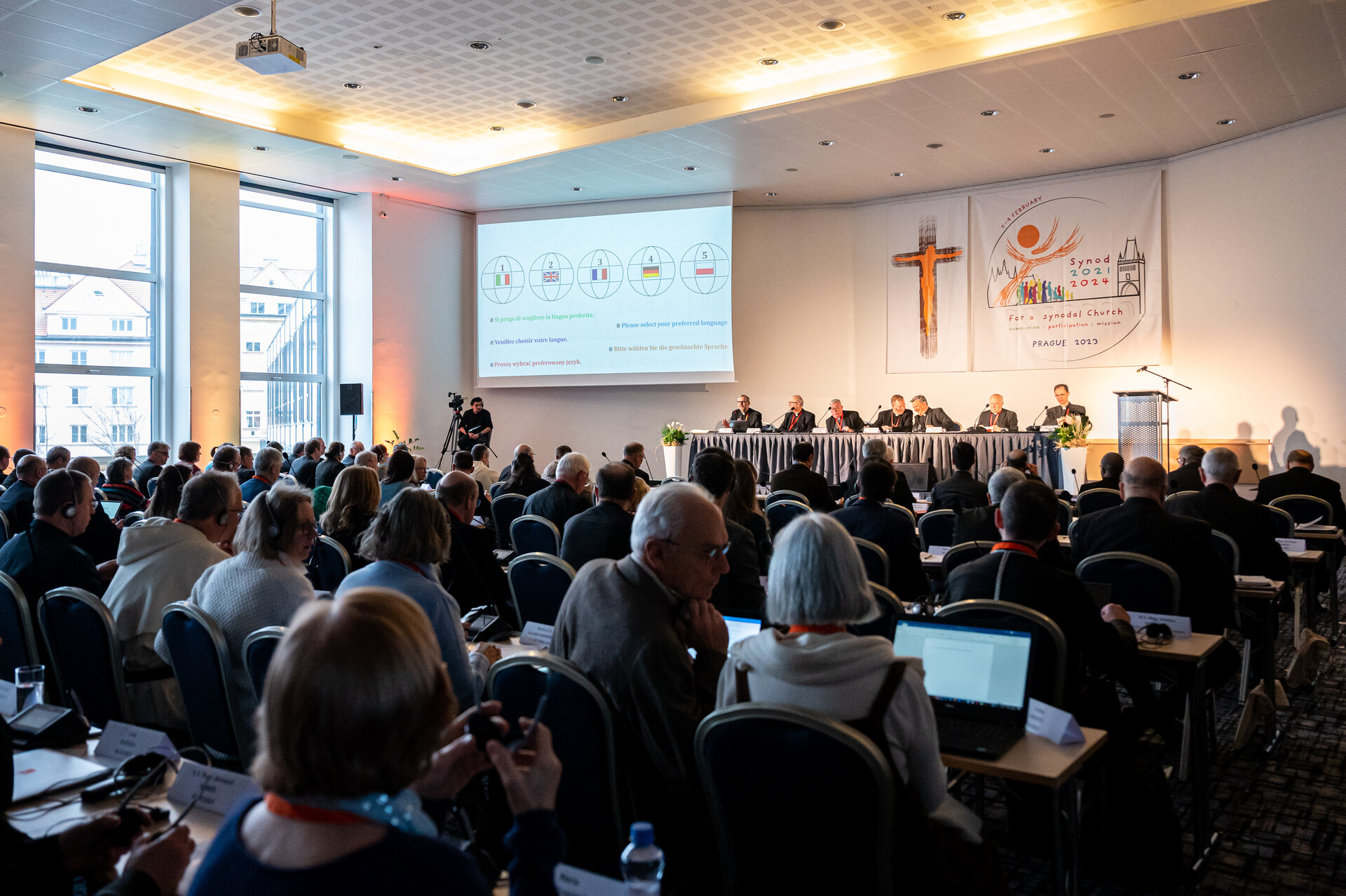
Your Eminences, Excellencies, delegates of the bishops’ conferences, distinguished guests, Welcome. We gather today in Prague for the Continental Assembly of the Synod on synodality. Pope Francis, in fact, wanted the preparation for the Synod to also pass through this intermediate stage, which would gather and synthesize what the Church in each continent really feels. … Skaityti toliau

Divine Mercy Summit 2022, Oct. 2-5

The Divine Mercy Summit 2022 begins with Mass from the Shrine of Divine Mercy in Vilnius on Sunday, October 2, and concludes the same way on the Feast Day of Saint Faustina, October 5, 2022.

Hosted by the Original Divine Mercy Institute, the summit will be broadcast LIVE from Vilnius, the First City of Mercy, featuring speakers, theologians, artists, musicians, historians, and experts from around the world. Also, join special guests, The Sisters of Merciful Jesus, and The Brothers of Merciful Jesus – the thriving religious orders Jesus asked for in His apparitions to Saint Faustina. List of speakers here.

This year’s theme is “The Art & Work of Mercy” – a prayerful exploration of what it means to receive, share, and cooperate with Divine Mercy in the world. Read more about this year’s theme.

Registration and the Summit is free.

www.divinemercysummit.com


On our knees before the Eucharist to invoke peace

On 14 September, the Feast of the Exaltation of the Holy Cross, following the invite of H. E. Msgr. Gintaras Grušas, Archbishop of Vilnius and CCEE President, a day of prayer will be celebrated to invoke peace for Ukraine.

Eucharistic Adoration is the common form of prayer chosen for this initiative: in all of the European Bishops’ Conferences liturgical aids and prayer schedules have been prepared for this appointment. Pastors and faithful, will gather together on their knees in front of the Blessed Sacrament to pray that the Lord will grant peace to Ukraine, taking up the very appeal of Pope Francis who called for each person to “be a builder of peace and to pray that thoughts and plans of concord and reconciliation will spread in the world”.

The European bishops have repeatedly joined their voice to that of the Pope in calling for a halt to arms, an immediate end to the war in Ukraine and efforts towards peace. They have made numerous appeals to the heads of nations and the international community to do everything in their power to end the current war that is destroying lives and causing untold suffering The Lenten initiative, called the ‘Eucharistic chain’, conceived as a sign of the Church’s closeness to the victims of covid and their families, this year also became an opportunity to pray for the victims of the war and invoke peace in Ukraine.

The Bishops’ Conference of the Roman Catholic Rite in Ukraine has declared 2022 the Year of the Holy Cross. In a letter published to mark the beginning of the Year of the Holy Cross, the Ukrainian bishops write: “Starting from February 24, since Russia attacked Ukraine, we are walking a painful road of the cross, on which innocent people suffer, are wounded and killed, there is a lot of evil, a lot of suffering! At this time, we feel more acutely than ever what violence against the innocent is, what the crucifixion of the innocent is. Now more than ever we understand Jesus Christ on His Way of the Cross, we understand His suffering and death as an innocent Lamb who was crucified by people who gave themselves to the service of evil”. The Year of the Holy Cross will end with a solemn Holy Liturgy and Way of the Cross with the participation of all Roman Catholic bishops of Ukraine on 14 September 2022, during the European Day of Prayer for Ukraine, at the Shrine of the Lord’s Passion in Sharhorod.

Personal Data Protection and Processing Rules

Approved by Decree No. S-365 of 28 May 2018, issued by the Metropolitan Archbishop of Vilnius, Gintaras Grušas Personal Data Protection and Processing Rules of the Archdiocese of Vilnius   CHAPTER I. GENERAL PROVISIONS SECTION ONE. General Provisions SECTION TWO. Terms and Definitions SECTION THREE. Controllers and Processors SECTION FOUR. General Requirements Personal Data Processing … Skaityti toliau